- President’s Message
- Conservation Corner – High Water Tests Section 3 Restoration Project
- Cedar Bog Nature Preserve
- A New Record
- Big Walnut Middle School Service Day Event
- Trout Fishing Quest
- Upcoming Events
President’s Message
“Many men go fishing all of their lives without knowing that it is not fish they are after.”
— Henry David Thoreau
As summer settles in across Ohio, many of us are finding our way back to the water. Longer days, evening hatches, and early mornings on the Mad remind us why we care so deeply about this river and the resources that support it.
I want to start by thanking everyone who attended our Annual Meeting this spring. It was great to see familiar faces, meet new members, and spend time discussing the future of our chapter and the Mad River watershed. The continued support of our members is what makes our work possible. As noted in our Accomplishments Report, TU Mad River Chapter members and other volunteers donated nearly 2300 hours of their time between 4/1/2025-3/31/2026. The report will be available on the website.
I’d also like to thank all of the volunteers who give their time and energy throughout the year. Whether you’re helping with stream restoration projects, water quality monitoring, educational programs, chapter events, or simply lending a hand when needed, your efforts make a real difference. The strength of our chapter has always come from members who are willing to roll up their sleeves and get involved.
One of the things I appreciate most about our chapter is that there are opportunities for everyone to contribute. You don’t need to be an expert angler or conservation professional to make an impact. If you care about protecting coldwater resources and enjoy spending time with people who share that passion, we’d love to have you join us at an upcoming project or event.
As we move through the summer, we’ll continue supporting conservation efforts throughout the watershed and providing opportunities for members to get involved. I encourage you to take a look at the upcoming events listed in this newsletter and consider joining us. New volunteers are always welcome, and many lasting friendships have started while working together on behalf of the river.
Most importantly, I hope you find some time to enjoy the river itself. Take a kid fishing. Introduce a friend to the outdoors. Spend a quiet evening on the water. The Mad River remains one of Ohio’s special places, and every one of us plays a role in helping protect it for future generations.
Thank you for your continued support of Trout Unlimited and the Mad River Chapter.
I hope to see you on the water this summer.
Tight Lines,
Steve Moore
President
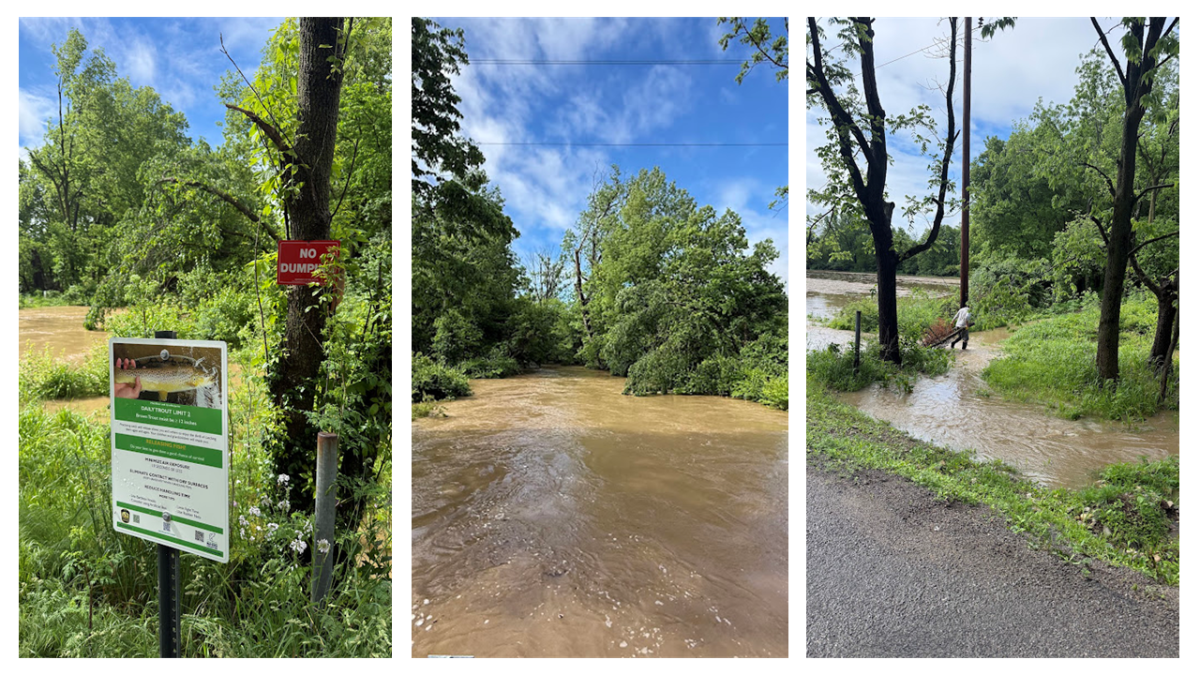
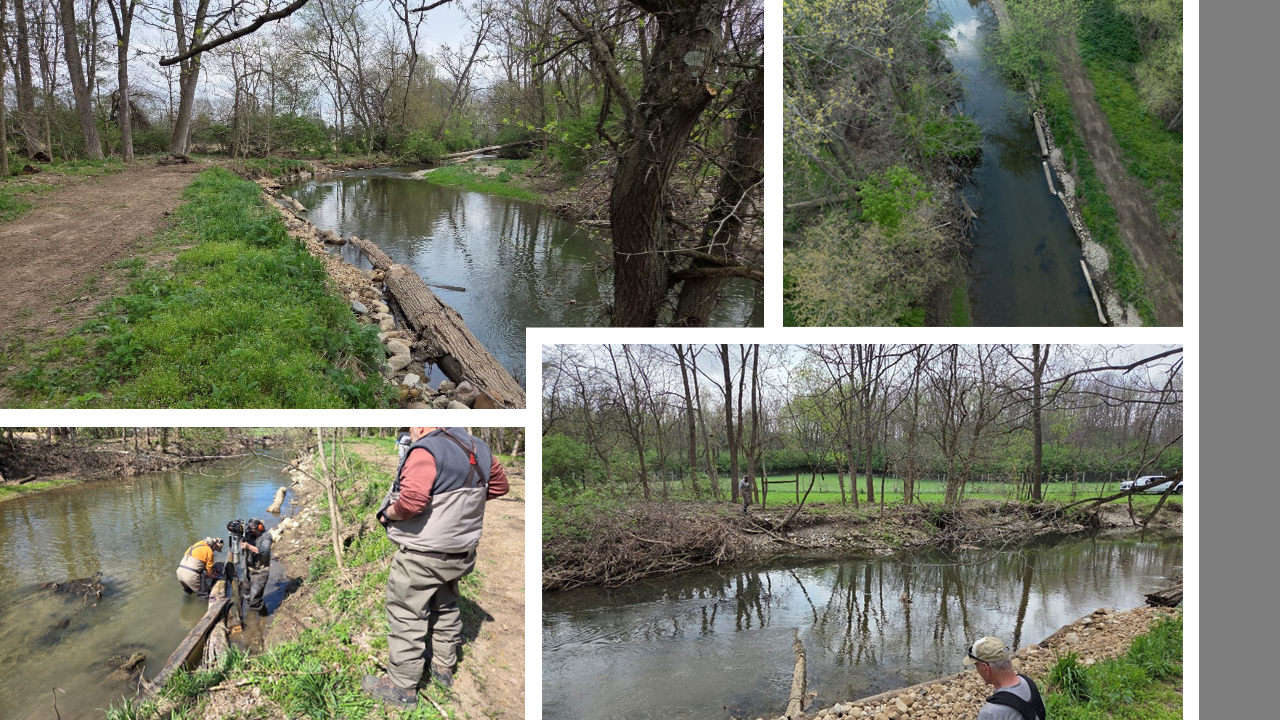
High Water Tests the Pimtown Rd Section 3 Restoration Project
by Tom Allen, Conservation Chair, TU Mad River Chapter
As described in the March issue of The Mad River Drift, the Section 3 habitat restoration project near Pimtown Road was the culmination of years of planning, design, permitting, and partnership. Following permit approval from the U.S. Army Corps of Engineers in December, work began with several days of site preparation before construction was completed in late March and early April.
The project included the installation of more than 40 cabled logs and nearly 270 tons of cobble along approximately 280 feet of streambank. The goal was to reduce bank erosion, improve habitat complexity, and maintain cleaner spawning and aquatic habitat by limiting the accumulation of fine sediment within the stream channel.
Only a few weeks after construction was completed, the project area—and the Mad River watershed as a whole—faced a significant test. Heavy rainfall pushed flows at the Urbana gage to nearly 4,000 cubic feet per second. These high flows carried tremendous energy through the river system, causing erosion along vulnerable streambanks and transporting large amounts of sediment and debris downstream.
What stood out during this event was not only the in-stream erosion, but also the amount of overland erosion occurring across the landscape. In many locations, runoff flowed directly from agricultural fields into streams and drainageways, carrying soil, crop residue, corn stalks, sticks, and other debris. While some debris accumulation was observed within the project area and additional assessment is still underway, the impacts extended far beyond any single restoration site. The entire river system experienced the effects of this runoff.
Events like these highlight an important reality: stream restoration alone cannot solve watershed-scale erosion problems. While projects such as Section 3 help stabilize banks and improve habitat locally, long-term success depends on addressing runoff before it reaches the river.
This is where the Mad River watershed’s natural features act as the watershed’s sponges, slowing runoff, storing water, trapping sediment, and reducing the energy of flood flows. The Mad River is home to some of Ohio’s most significant groundwater-fed wetlands and calcareous fens, which help regulate streamflow and support the exceptional water quality for which the river is known. Protecting and restoring these natural systems is every bit as important as in-stream habitat work.
We must also continue exploring ways to reduce overland flow and soil loss from agricultural lands. Practices such as filter strips, cover crops, grassed waterways, restored wetlands, and strategic conservation plantings can help keep valuable soil and crop residue where they belong—on the land rather than in the river.
Addressing these challenges will require cooperation among landowners, farmers, conservation organizations, watershed groups, and local, state, and federal agencies. By combining stream restoration with watershed-scale conservation efforts, we can improve resilience to increasingly intense rainfall events while protecting both agricultural productivity and the health of the Mad River.
Looking ahead, additional restoration work is planned this summer at Mac-O-Chee Creek near Lower Pitt Castle and at the West Liberty Lions Club Park. Both projects have received funding and will focus on improving stream and riparian habitat conditions. Members of our club will be assisting with in-kind services, including invasive species removal and other stewardship activities that support the long-term success of these restoration efforts. These projects represent another important step in protecting water quality and enhancing habitat throughout the watershed.
The recent floods served as an early test of the Section 3 project. They also served as a reminder that the health of the Mad River depends not only on what happens within the channel, but throughout the entire watershed.
Want to lend a hand? We’re always looking for more boots on the ground—and in the water. To get involved with upcoming workdays or trail projects, reach out to Tom Allen at ptallen111@insight.rr.com.
Glacial History of the Mad River Watershed
by Tom Allen, Conservation Chair, TU Mad River Chapter
Because of the unique glacial history of this area, the Mad River watershed contains an unusually rich network of wetlands, fens, and unique natural features. These areas play an important ecological role and are closely connected to the quality and quantity of our water resources.
Some places, like Cedar Bog and Owens Fen, are protected, but other important areas remain vulnerable.
In this issue we’re including an article about Cedar Bog (it’s actually a fen).
In future newsletters we’ll highlight wetlands, fens, and nature preserves throughout the Mad River watershed, along with ways people can learn more and get involved.
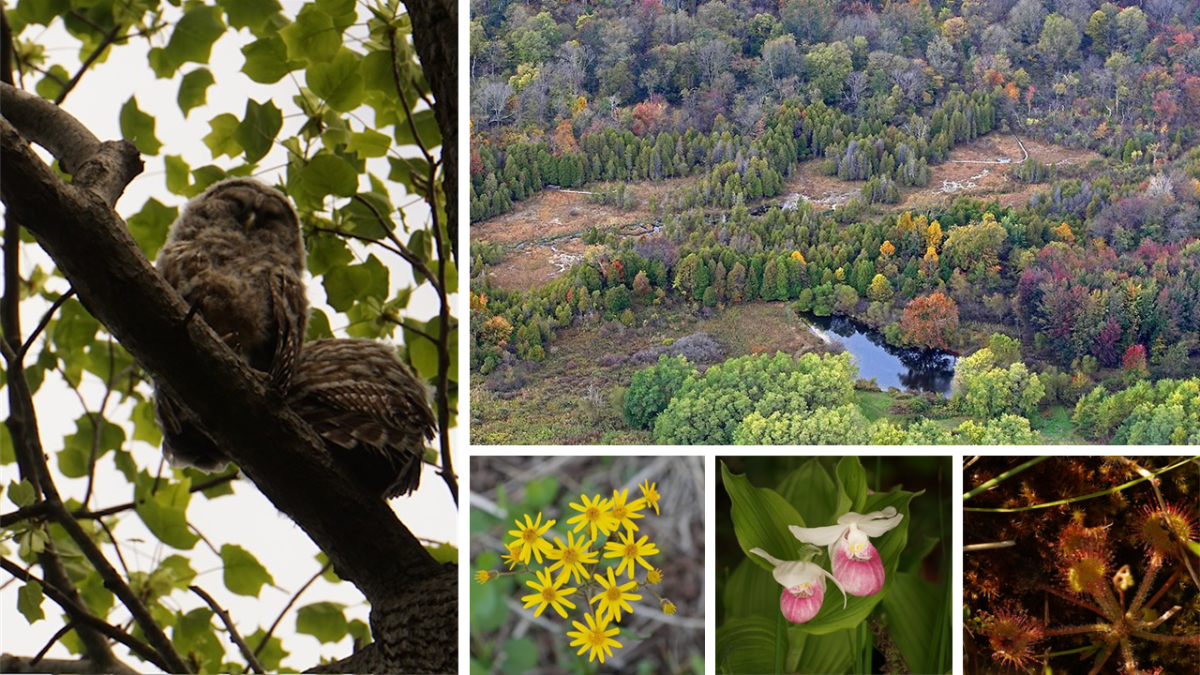
Judy Page, Vice-President, Cedar Bog Association
Cedar Bog Nature Preserve is an extraordinary little piece of Ohio’s natural history. From a purported 7,000 acres of wetlands originally in the area, we are whittled down to 450 precious acres.
The beginnings of Cedar Bog (which is a fen) are the many glaciers that covered parts of Ohio, the last, about ten to thirteen thousand years ago. Glaciers from Canada plowed the landscape, then retreated leaving gravel, seeds and other debris, and a cool, moist climate at its edges.
The Bog is fed from the ancient Teays River which bubbles up through the limestone gravel beds left by the glaciers. It is cold and alkaline, maintaining the surface water temperature at about 50 degrees all year round (ground water closer to the surface and rain water also feed the Bog). This cool microclimate helps to maintain some of our rarest glacial relicts like the showy and small yellow lady’s slipper orchids, the white cedar, and sedges!
About 6,000 to 2,000 years ago the earth warmed and many prairie species from the Midwest and coastal plains found their way to the Bog. You’ll see prairie dock and liatris in the fen meadows, although not quite as robust as they would be in drier prairie soil. Other prairie species can be found throughout the Bog including big and little bluestem grasses, queen of the prairie, and prairie valerian.
There are over 40 rare, endangered or threatened species in the Bog. It has the highest plant diversity of any site in Ohio, and the finest example of a boreal fen. The Bog is one of the few sites in Ohio that is home to the seepage dancer and elfin skimmer dragonfly, and the massasauga rattlesnake, all endangered in the state of Ohio. Cedar Bog is a dedicated nature preserve, a national natural landmark, and part of the Old Growth Forest Network. It is a very special place, indeed.
Cold, clean water is vital to the survival of Cedar Bog Nature Preserve, its unique flora and fauna, and by extension, to the Mad River! There is a constant flow of cold groundwater up to the surface and across the Bog’s landscape. The sedge meadows filter out sediment, nutrients, and pollutants. This not only maintains the cool climate and alkalinity to maintain our flora, but since it flows into the Mad River, helps to maintain the river’s temperature, quality and flow.
There have been many threats to Cedar Bog through the years including using it as a cattle lot, running a by-pass through it, but currently we keep an eye on how farmers’ irrigation and chemical use impact the Bog, as well as climate change. Perhaps our biggest threat is a proposed data center which would sit less than 2 miles northeast, right atop the aquifer and recharge area for the Bog. More and more negative impacts of data centers are being reported from communities around the United States. A change in water temperature, quantity or quality could devastate Cedar Bog. Those of us who love the Bog will do everything we can to protect it.
References:
Bob Glotzhuber, AOA, Terry Jaworski
Cedar Bog offers monthly events. See our FB page or website for a full list. To keep up with data center news see our Cedar Bog Association FB page which is separate from the Cedar Bog Nature Preserve FB page.
June 20th Jim McCormac will speak on Birds of the Bog
We are always in need of committed volunteers! Whether it be pulling garlic mustard, leading tours, welcoming guests, there is a place for you! Call Maddie at 937-484-3744.
Thanks, and come visit soon!
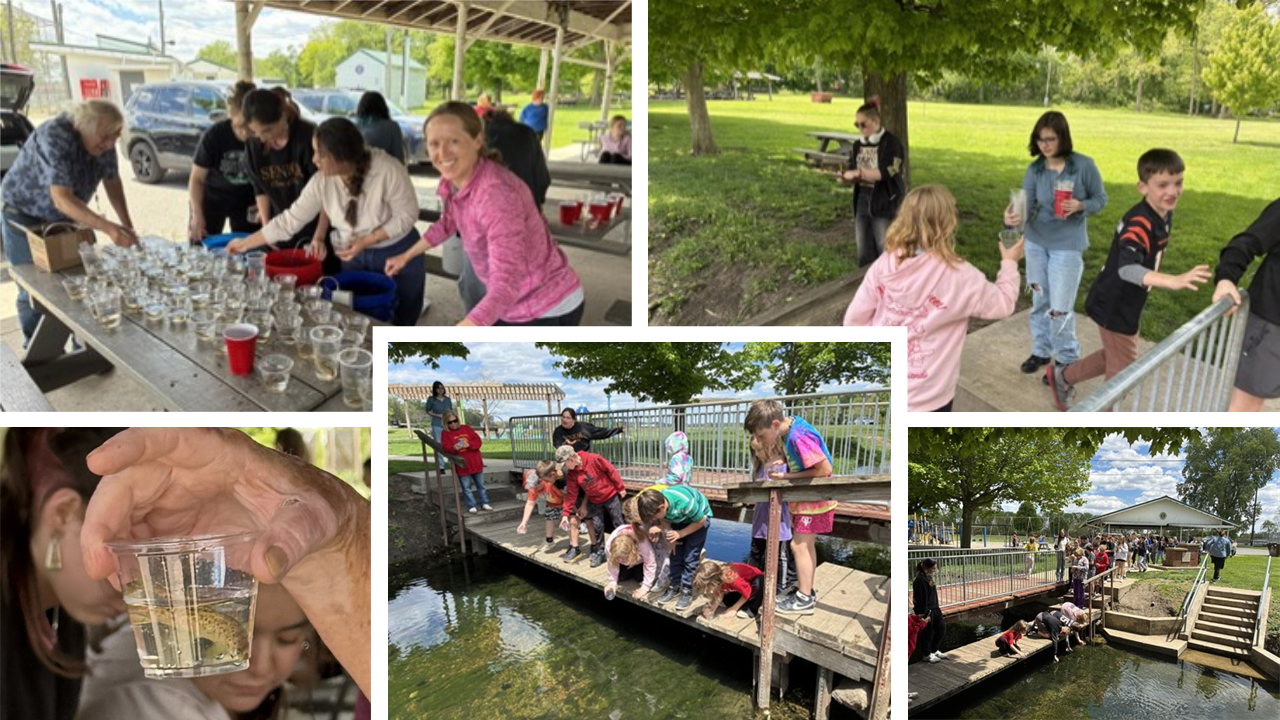
by Bruce Smith, Teacher, Benjamin Logan Schools
For fifteen years Benjamin Logan students have raised and released trout into the Mad River system through a program called Trout in the Classroom. This year a record was set as 201 brown trout fry were set free into Onion Run, a Mad River tributary, in the Lions Club Park in West Liberty. Students from the high school, middle school, and elementary schools all participated in the event which was also attended by parents and other community members.
The story began last fall when 100 eggs from the Ohio Department of Natural Resources Division of Wildlife hatchery in London, Ohio were delivered by a Trout Unlimited volunteer to specially equipped aquaria located in each of the three Benjamin Logan buildings. As the eggs hatched, students took on the role of feeding and monitoring water quality ensuring that the developing fish would be raised in the cold, clean water that they require in the wild. Because of its ground water discharge, the Mad River, which arises in the Benjamin Logan School District, is one of the few ecosystems in the state that can support trout year round.
Trout in the Classroom, sponsored by Trout Unlimited, who have been protecting cold water fisheries since 1959, coordinates the project which includes a curriculum for all grade levels. For more information contact Trout Unlimited at https://tumadriver.org
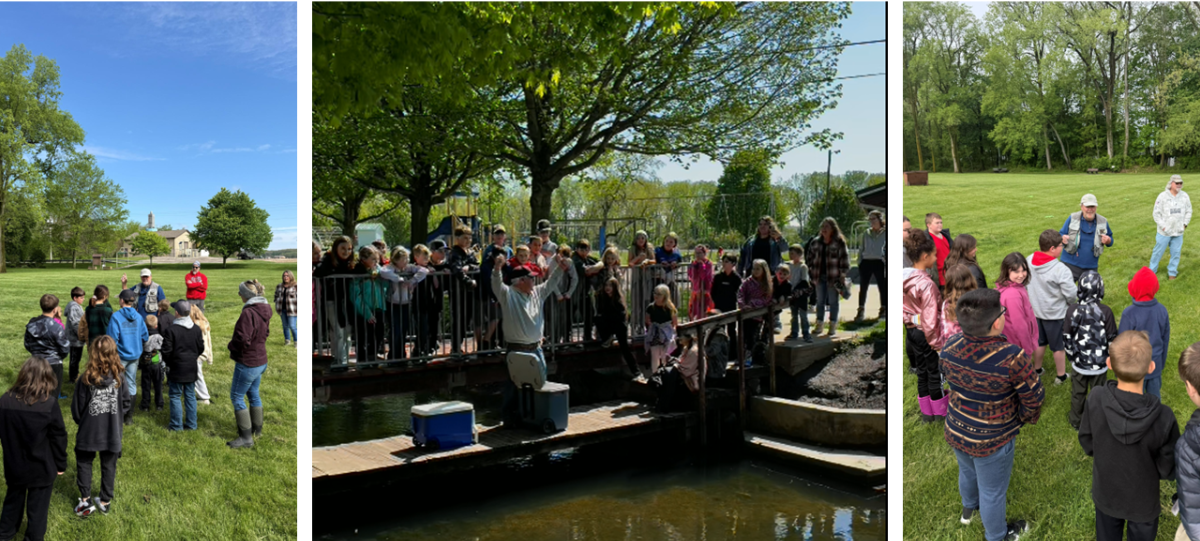
by John Davis, Mad River Chapter TU Board Member
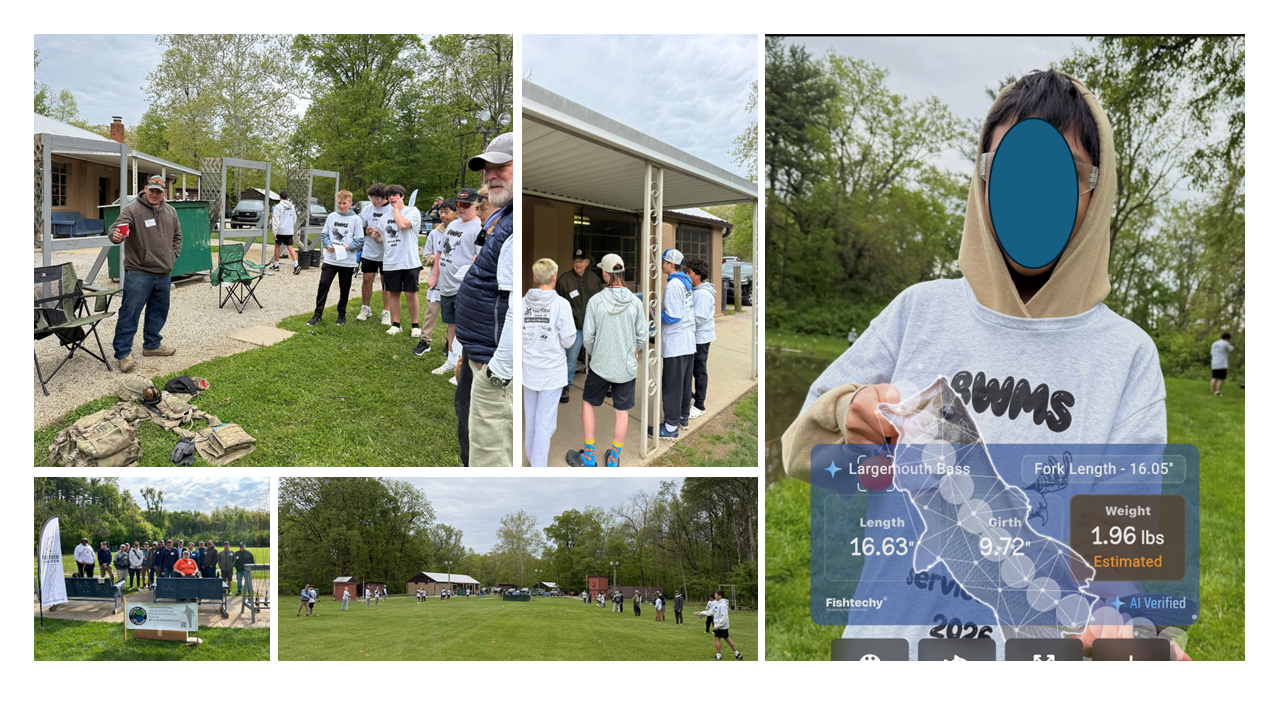
Several years ago, Josh Frame, the principal at the Big Walnut Middle School in Sunbury, Ohio, approached me about starting a service day project in which all the school’s students would spend a morning providing some sort of community service such as working at the local animal shelter, visiting residents of local nursing homes, weeding, edging, and mulching local park beds, etc.
Knowing that I was a fly fisher and that I worked with veterans, Mr. Frame thought it might be a good educational opportunity for the students to spend time with veterans while learning first-hand about the veterans’ military experiences in addition to acquiring some knowledge about fly-fishing and conservation.
That was two to three years prior to COVID, which resulted in a two-year hiatus in the service day activities before restarting the event. Those early students and vet pairings have become one of the more popular service day event activities. For the last three years, our Mad River Chapter of Trout Unlimited has joined forces with the Central Ohio Fly Fishers and The Land of Legend Fly Fishers out of Newark, Ohio and the Ohio Department of Natural Resources, Division of Wildlife in providing a volunteer guide and instructive team for students, veterans, and active military personnel. This year’s event was held on May 8th. As in the previous years, our instructional team provided safety tips as well as casting instruction for the veterans and students. Prior to pairing the students with a guide and a vet and hitting the water, the students were given an interview packet with some suggested questions they might ask the veterans in addition to their own questions. During these interview segments, the veterans gain acknowledgement and appreciation from the students and in turn, the students learn a bit about the various roles, duties, and job responsibilities undertaken by the veterans during their time in the military.
One active military service participant is a graduate of the middle school as well as the high school. He is assigned to the Ohio National Guard as a detonation and munitions expert and has participated in this event for two years. Through the years we have had veterans from the Army, Navy, Air Force, and Marines including WWII, Vietnam, the Persian Gulf, and the Iraqi Freedom eras.
One student this year had never fished, but caught an almost 2 lb., 16+ inch, largemouth bass. When I returned to the school, the participating students at this event were all abuzz with excitement. One caught, nine fish, another shared that he had caught a blue gill, a crappie, a bass, and a catfish! Several had questions about how and where to acquire equipment and how they might learn more about this new form of fishing.
A big shout out to the Mad River Chapter TU guides, the C.O.F.F. guides, and The Land of Legend Fly Fishers guides, and to John Farson of the ODNR who shared their time and skill sets benefitting our deserved military personnel as well as exposing a new generation to this affliction we know as fly-fishing. We extend our appreciation to Big Walnut Middle School, Sunbury, Ohio for this multi-year educational opportunity as well as the Big Walnut Conservation Club for serving as the site host for this event. Of course, this event could not occur without the veterans stepping up to share their experiences, contributions and sacrifices for which we are eternally indebted and appreciative. A special thank you to each of you!
by Steve Cameron, Oklahoma City
Tom has asked me to share a little bit about my quest to catch a trout in every state!
I want to share that this wasn’t planned at first. It came about on my way home from fishing the Meramec River in Missouri. I fished some pretty water and caught a couple of nice rainbows, and it was on my way home that I thought, you sure do like catching those trout fish, and they always live in pretty places. So the quest was on!
I started my quest in September 2023 with nine states already in my creel, so to speak, and I am now at 36 and counting!
Tom wanted me to share some of the best places and fish I’ve caught, which is tough, but I’ll try to mention a couple from my trip out West last fall and the Northeast this past spring.
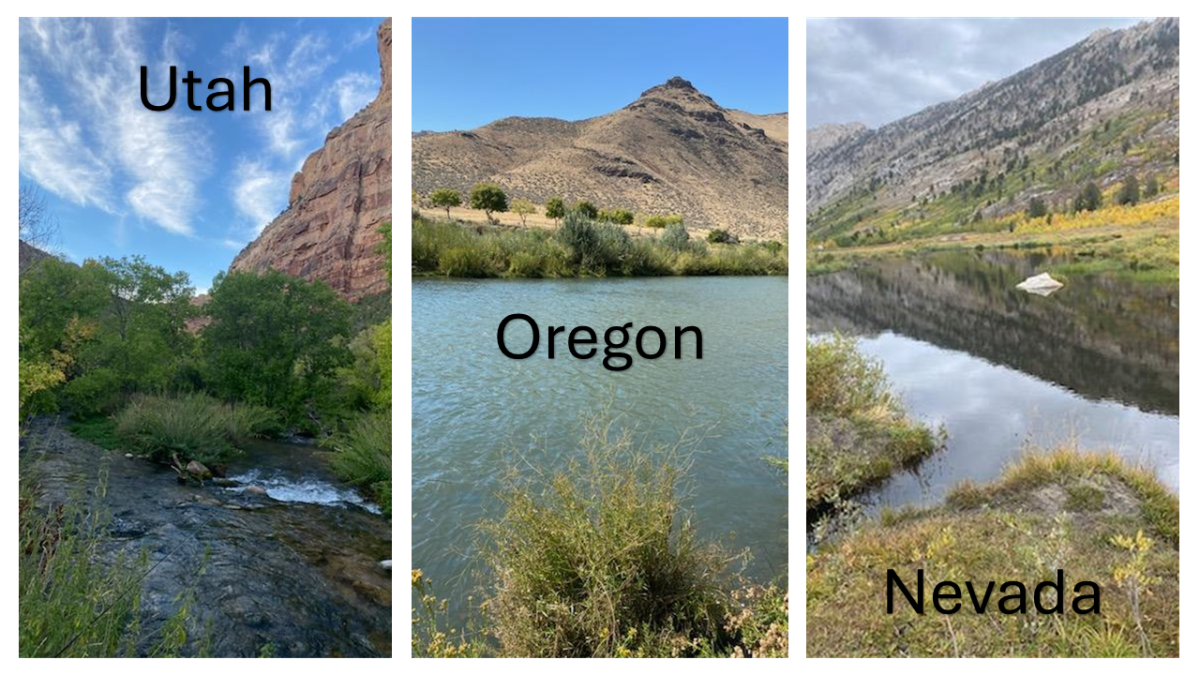
On my trip out West in September, trying to check off the six states I needed to cover all the states west, south, and north of me, my first stop was Jones Hole Creek in southeastern Utah. It was a beautiful piece of water with rippling runs and deep pools flowing through a mountain canyon just as the sun was coming up and shining through the canyon. You know, sometimes it doesn’t matter if I catch any fish because of where they live, but I was blessed to catch a brook trout about 6–8 inches, a little brown about the same size, and lose a slightly nicer rainbow. With pictures taken, I headed up to Flaming Gorge Lodge, where I was base camping for a day or two.
I was able to check off Wyoming and was on to Boise, Idaho, where I caught two nice rainbows out of the Boise River. But the Owyhee River in Oregon was the prettiest. It ran through a large canyon with cliffs, plateaus, and colorful rock strata throughout. It was a piece of water with nice long runs flowing into ripples and fast water, all with a beautiful aqua-blue-green color.
After I found a spot that looked good and that I could get down to—because I’ve learned I’m not the goat I used to be in my younger days ☺—I lost a little brown trout about 8–10 inches and then was able to land another brown that went 14–16 inches and put up a pretty good fight. But like my dad says, they fight more like a catfish than a rainbow. It was fun, though, and with Oregon and Idaho checked off and pictures taken, it was off to Elko, Nevada.
There, I fished a stream flowing into a beaver pond that was full of little brook trout. They were just beautiful with their different colored spots. No two fish were the same! The pond was in Lamoille Canyon, which had broken sunshine and scattered misty showers throughout the day. I also had to hide behind little bushes to stay hidden from the fish. I loved it—it reminded me of fishing beaver ponds with my dad in the mountains of New Mexico.
I caught a number of brookies, including a couple over eight inches, and stayed until a heavier rainstorm moving down the canyon chased me out. I was able to check off Arizona a day or two later, which helped me put the six states I needed out West into my creel.
The next leg of my quest was this past spring in April, with the hopes of putting eight more states into my creel.
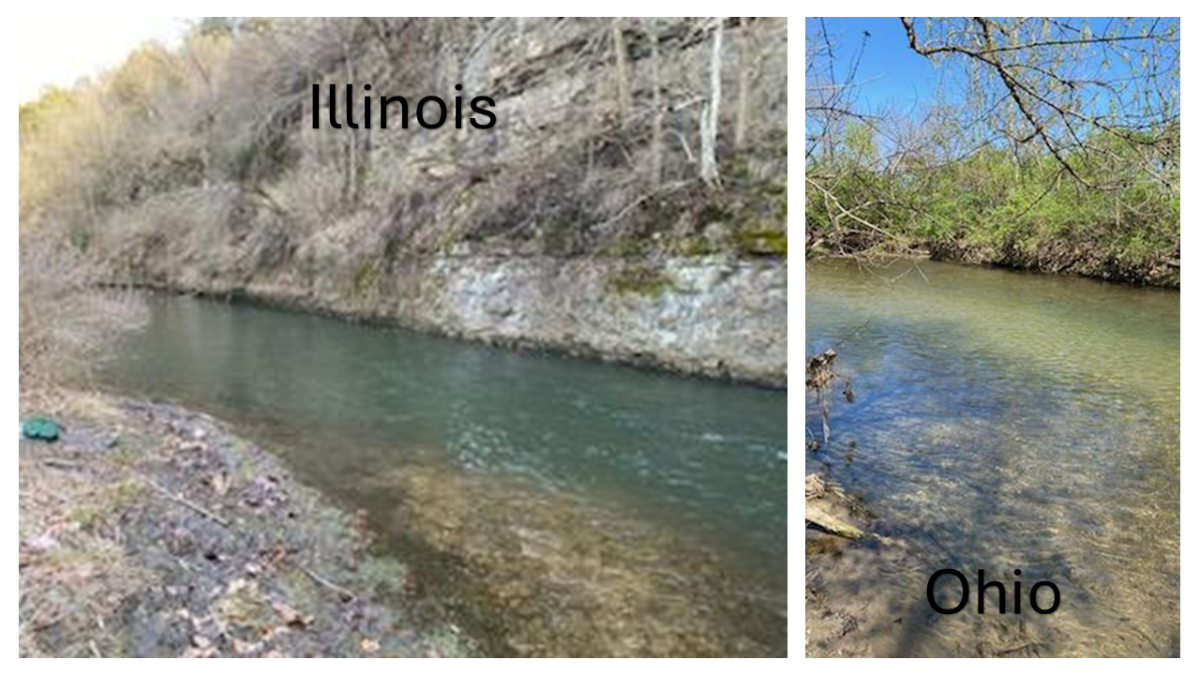
My first stop was at White Pines Lodge in White Pines State Forest, in Illinois. The stream I fished was just down from the lodge and flowed through an open canyon, cutting through the canyon walls with flowing pools, shallow riffles, and nice long deep runs along the cliff walls. It was a pretty piece of water with the sun setting as I fished.
I hooked a nice 2-pound-plus rainbow from a pool flowing into a deep run along the cliff face. It put up a nice fight with a couple of good runs, and just when I thought he was ready for the net, he took another run and parted my line. Sometimes that happens, but it was one of the best fights on this part of my quest.
I caught two more nice rainbows, one around a pound and another a pound and a half or better, in another long run along a cliffside just downstream. Both put up nice fights and made a couple of good runs. I got my pictures and was off to Indiana and Michigan. After a couple of days of challenging fishing, I was able to put them in my creel too.
My next stop was Ohio to fish the Mad River that Tom had told me about and shared where to fish. I got to the northwest parking spot across the bridge, and after walking upstream a little ways, I found a spot with a cutout in the bank across the river. It had a nice flowing current that emptied into a longer, wider, deeper run.
This was such a pretty piece of water. It was so clear—you knew there were fish there, you just couldn’t see them!
I caught one brown trout about 8–10 inches and then a 14-inch-plus rainbow that tail-walked for me three different times and showed me that “rainbow” in the sunshine. It was awesome and one of the few fish on my trip that came completely out of the water for me!
I got my pictures and put Ohio in my creel. I fished four more states and was able to put three more in my creel as well. The one that eluded me will go on the list for my New England trip this fall.
Well, I hope you’ve enjoyed hearing about some of the places my quest has taken me so far. There have been many others too, along with some great and friendly people who have helped me along the way. Once they learn about my quest, they often share their stories, where to fish, and what to fish with.
As I’ve always said, I am more blessed than I deserve.
Best of luck to everyone the next time you’re on the water—tight lines always!
From OKC,
Steve
Upcoming Events
Latest News
- One Calendar for Our Fly Fishing & Outdoor Community
- Mad River Drift Newsletter - September 2026
- 10/16/26 -International Fly Fishing Film Festival at Nocterra Brewing, Powell
- Mad River Drift Newsletter - June 2026
- Cancelled — Saturday’s Stream Water Quality Monitoring
- Reminder: Mad River TU Annual Meeting – April 18
- Mad River Drift Newsletter - March 2026