President’s Message
Boundaries don’t protect rivers, people do.
~Aristotle
I came across this quote a few days ago, and it really struck a chord within me. In my opinion these words by the great philosopher Aristotle are more important today than they have ever been before. It also aligns perfectly with TU’s dedication for the conservation, protection, and restoration of North America’s cold water fisheries. Locally, our chapter strives to bring people together to help make both the Mad River and our communities healthier!
With that said…. After what seems like an endless summer of heat and very little rain, I am eagerly awaiting to see what the fall season has to offer us. Fall is also my favorite season for fishing as trout begin to feed in preparation for spawning season, and the coming winter months. As we flip the calendar into September, thoughts of cooler, crisp air coupled with fish on the bite always brightens my mood.
As always, our chapter has been extremely busy this summer. We worked extensively with the Ohio Council of Trout Unlimited to ensure that we were recommended for rechartering. Our Board detailed for submission our activity within our multiple restoration projects, our water quality monitoring program, our river clean ups, as well as our extensive outreach and education. To that end I am pleased to announce that Council did approve a recommendation for our chapter; so we will be continuing as grateful stewards of the Mad River for the foreseeable future!
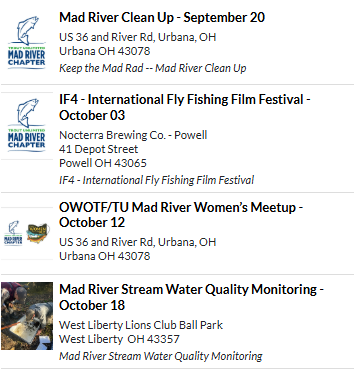
We are looking forward to several fall activities that we have on the calendar which will be further detailed within the newsletter. Our annual large-scale Mad River Cleanup will be held on September 20th. Our next water monitoring event will be on October 18th. We will also be having intermittent habit and stream restoration / repair dates both during the week and on weekends. As always, you encourage you to volunteer with us! These events are just as enjoyable as they are impactful to the health and protection of the Mad River.
Finally, I would like to invite everyone to come join us once again for the International Fly Fishing Film Festival (IF4) on October 3rd at Nocterra Brewing Co. in Powell. This event has been a tremendous amount of fun in the last few years, and we anticipate this years to be just as fantastic. Admission is completely free! In addition to the screening of the Film itself we will be hosting a Vendor Garden where you may explore fly fishing related gear and talk to people representing non-profits doing good things through the healing power of fly fishing. There will also be raffles and a silent auction that I will say has fantastic prizes, fly gear, and other items – all supporting conservation efforts. We would love to see you there!
As always, if you ever have anything you would like to contribute to future newsletters, please feel free to reach out to Pam Allen at pamallen@tumadriver.org. She is always looking for fun stories, experiences, fly recipes, or just photographs that can be shared for the greater good.
Tight Lines, Steve Moore, President
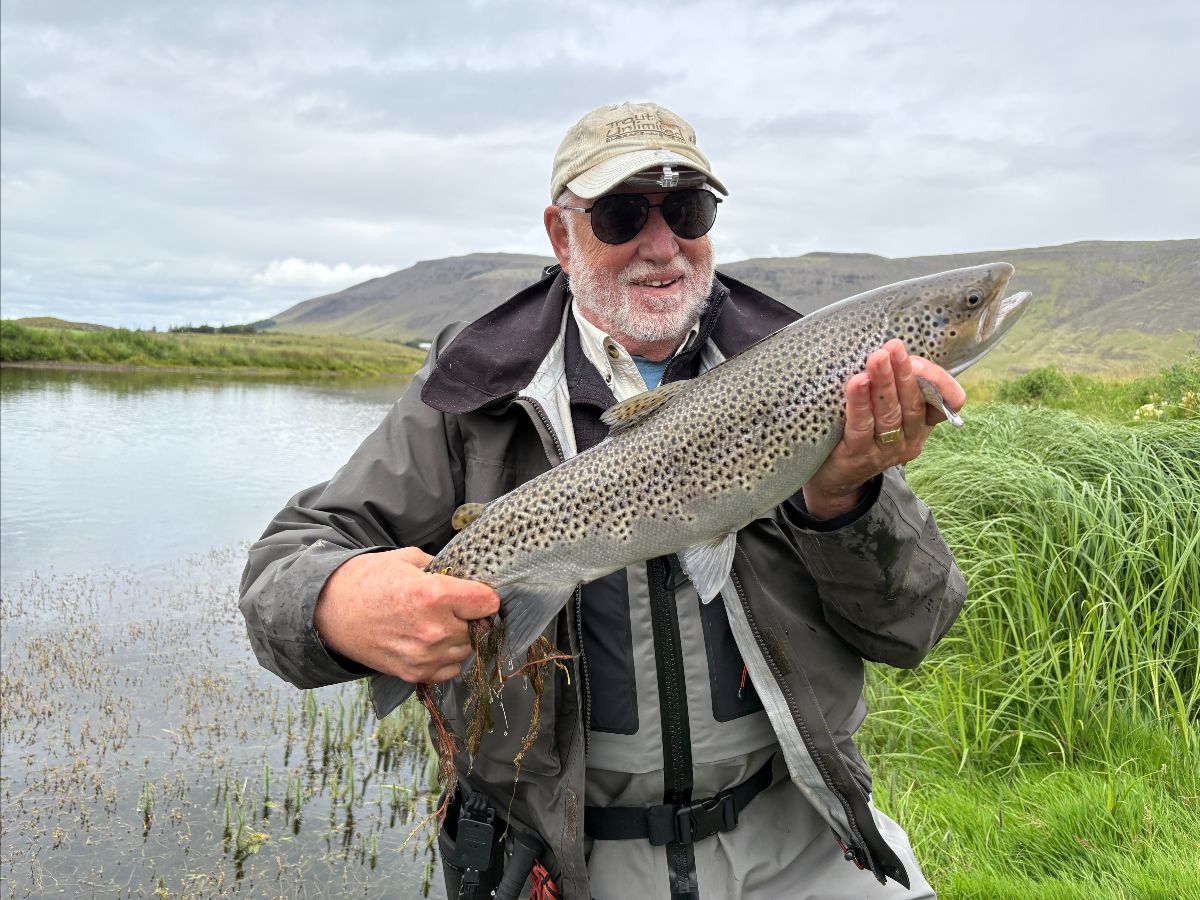
An Icelandic Adventure
by Don Antrim, TU Mad River Chapter Member
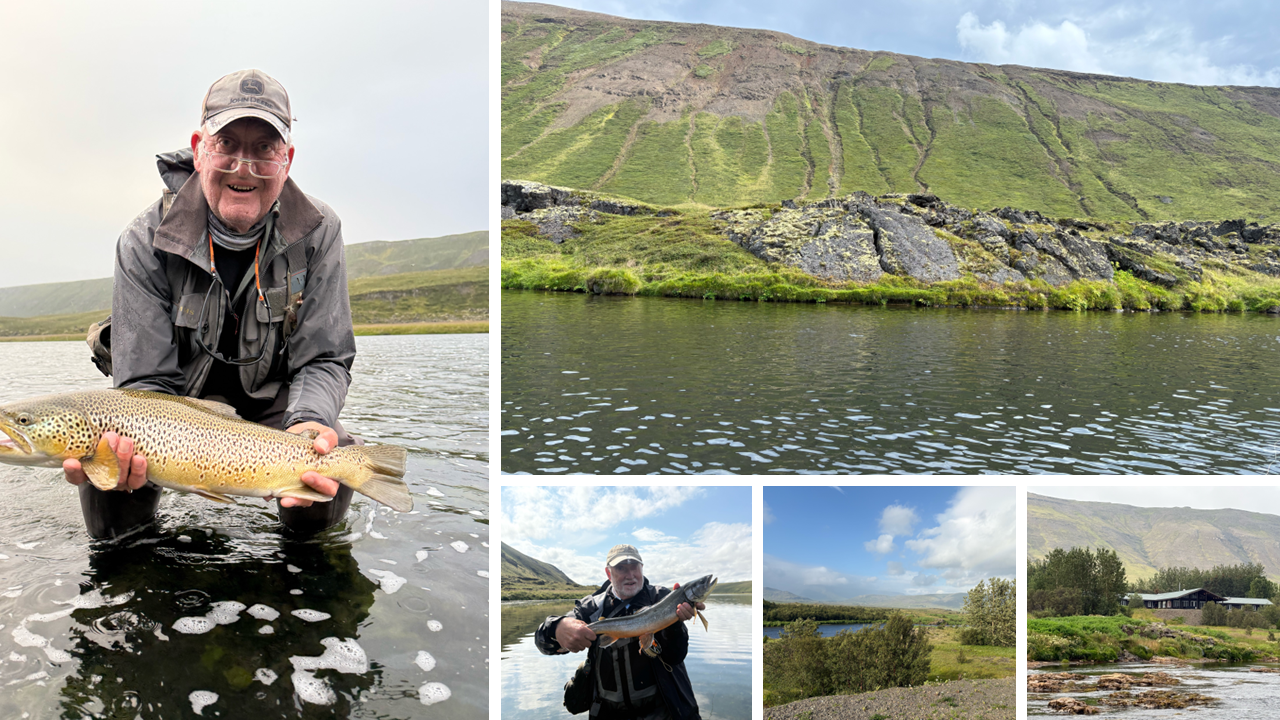
What a fabulous trip! The fishing was hard-earned but ultimately successful. The weather was almost too good—we had more sunshine than we wanted, and the rivers were low and had been running too warm. Thick mats of aquatic “salad” made things even trickier. Still, persistence paid off: we caught sea trout, salmon, Arctic char, and my friend landed a beautiful sea-run brown.
On one river, nearly all of our fishing—99%—was with dry flies, rarely larger than a #12. On the other, we switched to very small salmon flies (#14 and smaller) along with sedges for the sea trout. The technical challenge made every fish that much more rewarding.
The terrain on the first river was nothing short of brutal. We climbed up and down lava cliffs that tested both our legs and lungs. I had done a fair amount of prep, but in hindsight, more conditioning would have helped. Once in the river, wading was no easier—the boulders were quite large and difficult to navigate; almost no gravel or sand made footing difficult at best.
The lodges we stayed in could not have been more different. One was sleek and modern, while the other was a classic old lodge with, of all things, an open and seemingly endless bar. In both, the food was outstanding.
Reykjavik was its own highlight. The city was bustling with people, packed with fantastic restaurants, and dotted with charming coffee and pastry shops. We even enjoyed sunny outdoor lunches. One evening we dined in a seafood restaurant that may truly be the best in the world.
Of course, Iceland is as expensive as it is beautiful—but worth every krona. I would return in less than a heartbeat. My only regret is not experiencing it sooner, in my 40s or 50s, when, of course, both time and funds were harder to come by.
Iceland gave us everything: challenge, reward, beauty, and memories I’ll carry forever
Work Crew Update
by Tom Allen, Conservation Chair, TU Mad River Chapter
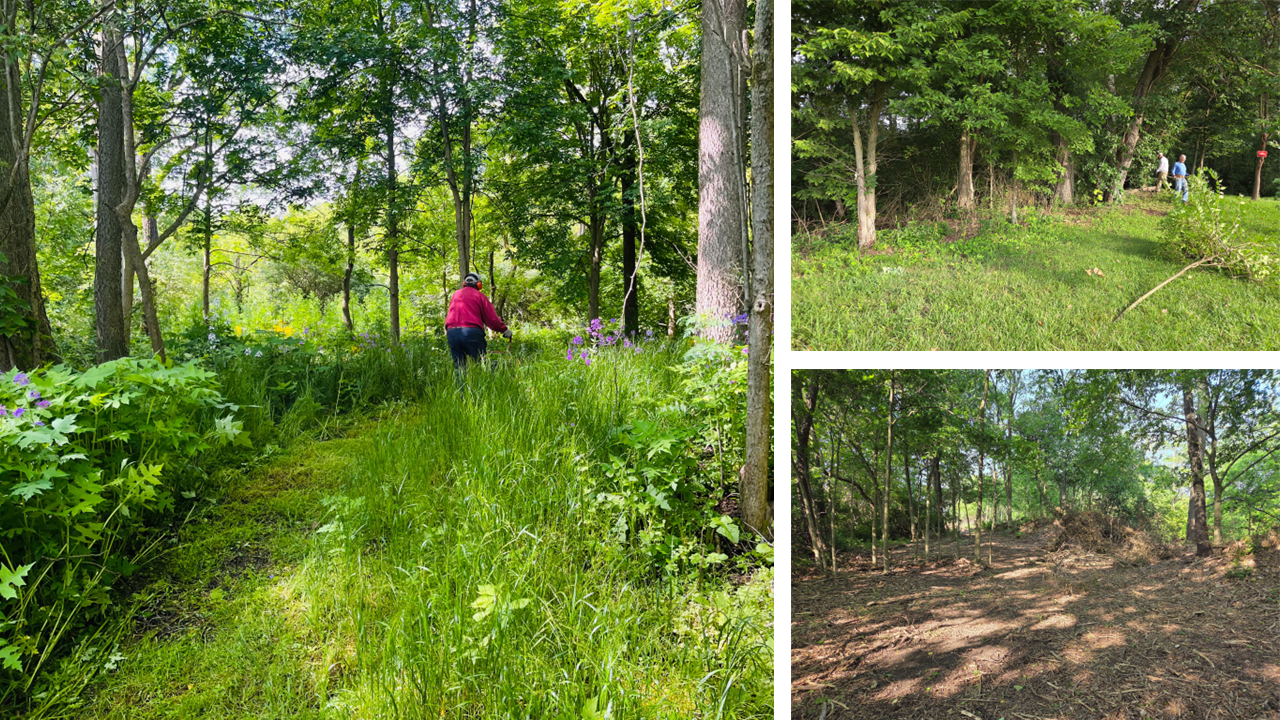
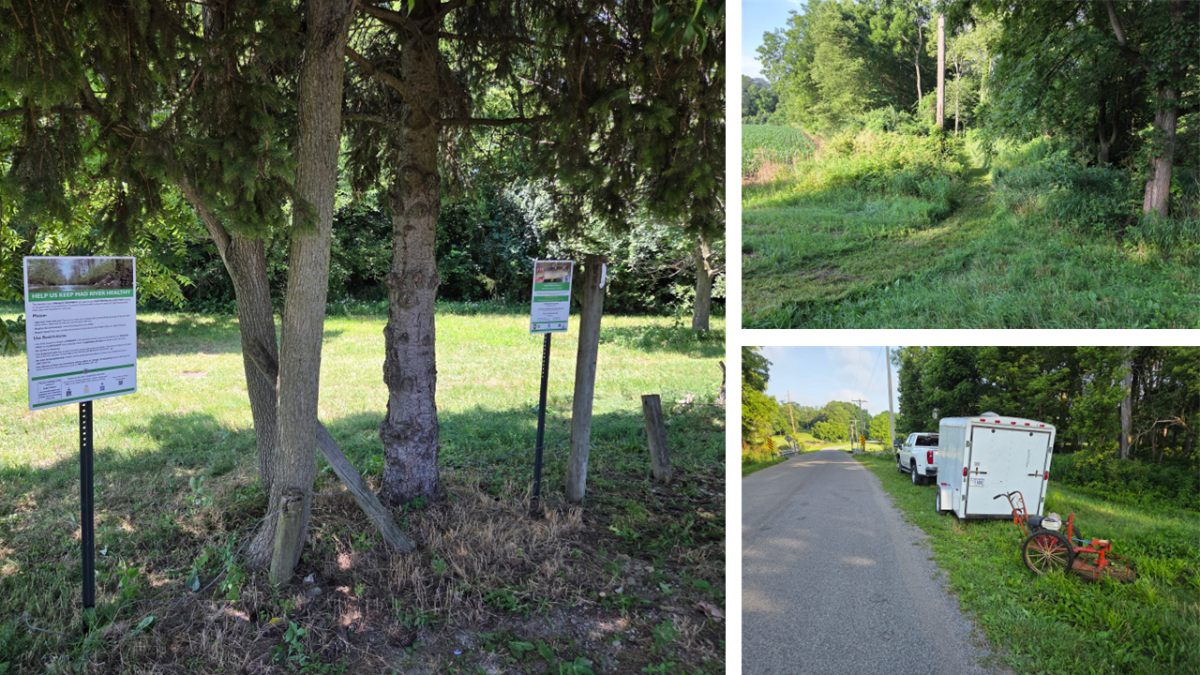
Over the past three months, our TU Mad River Chapter Work Crew has been busy maintaining trails and improving access at several key locations along the river. Crews put in hours at Pimtown, Watson’s, the access area at State Routes 29 & 296, and the US-36 access.
The bulk of our recent work has focused on cutting and removing invasive honeysuckle at the access area on the east side of the Mad. This effort stretched from Kings Creek to the State Route 29 bridge, and from the bridge downstream to the end of the state property. Clearing honeysuckle is tough work, but it’s essential for restoring healthy streamside habitat and improving angler access.
Looking ahead, we’ve developed a plan for additional in-stream habitat improvements at Pimtown, focusing on Section 3. If all goes well, we’ll be ready to conduct this work later this fall. If not, it will wait until spring.
Thanks to all the volunteers who continue to show up and lend a hand—your efforts make a visible difference for the river and the community that enjoys it.
Want to lend a hand? We’re always looking for more boots on the ground—and in the water. To get involved with upcoming workdays or trail projects, reach out to Tom Allen at ptallen111@insight.rr.com.
Cast a Line for Conservation: Volunteer for the Mad River Cleanup
– September 20, 2025
by Paul Cicconetti, TU Mad River Chapter
Fly fishing isn’t just about the catch—it’s about the water, the habitat, and the community that cares for it. That’s why the Trout Unlimited Mad River Chapter is calling on anglers and conservation-minded friends to join us for our Annual Mad River Cleanup on Saturday, September 20, 2025, from 9:00 a.m. to 12:00 p.m.
This year’s effort will span 18 river access points, from West Liberty Park to Mad River Gorge Park in Clark County. Together, we’ll be targeting trash and debris that threaten the health of this unique cold-water fishery.
Last year, more than 30 volunteers and 10 partner groups teamed up to pull waste from the riverbanks, improve public access, and restore the natural beauty of the watershed. The results were visible and inspiring. But with more miles to cover and growing community interest, we’re aiming even bigger in 2025—and we need your help.
Whether you’ve fished the Mad River for years or are just looking for a way to give back to the outdoors, this is your chance to make a tangible difference. Bring your waders, gloves, or just a willingness to pitch in. You’ll meet fellow anglers, connect with conservation groups, and leave knowing you’ve helped protect one of Ohio’s most treasured streams for the next generation of fly fishers.
Event Details:
Where: US-36 Bridge where it crosses the Mad River, West of Urbana, OH
When: Saturday, September 20, 2025
Time: 9:00 a.m.–12:00 p.m.
To sign up or learn more, contact:
Paul Cicconetti – paul.cicconetti@gmail.com / 330.988.3200
Let’s work together to keep the Mad River clean, healthy, and fishable—because the best fishing stories always start with a healthy river.
by John Davis and Ryan Kerns, TU Mad River Chapter
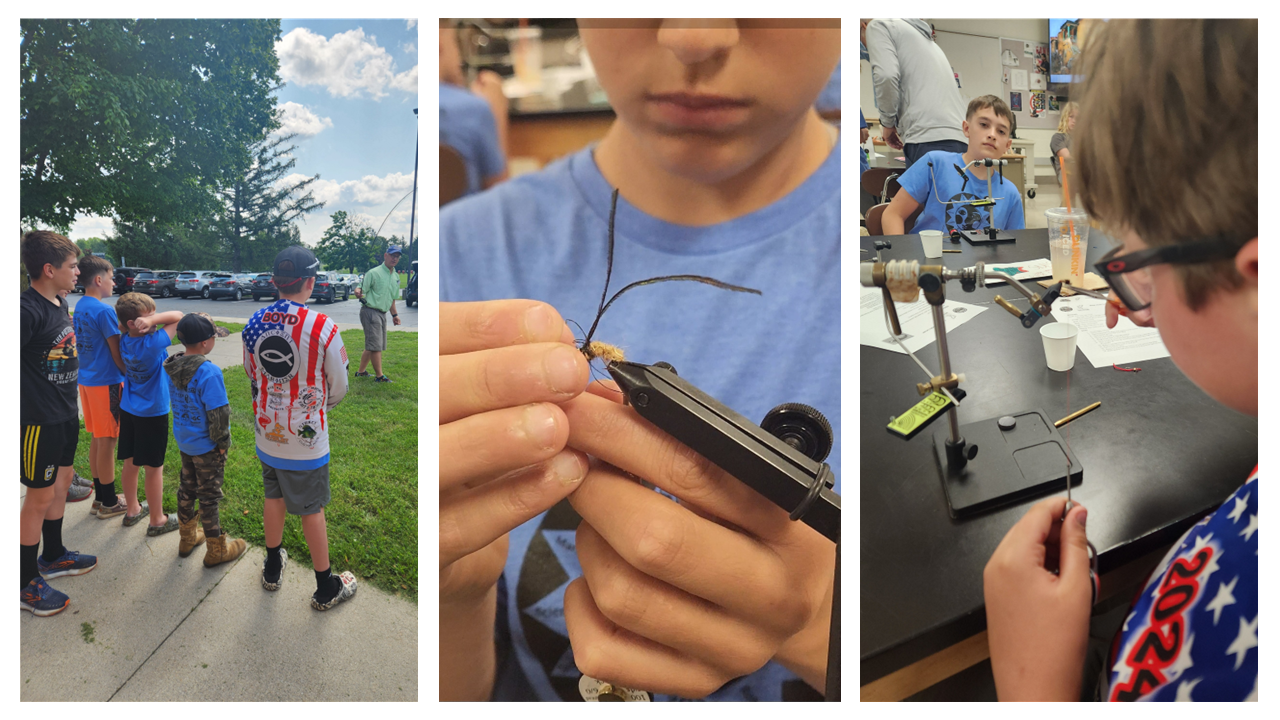
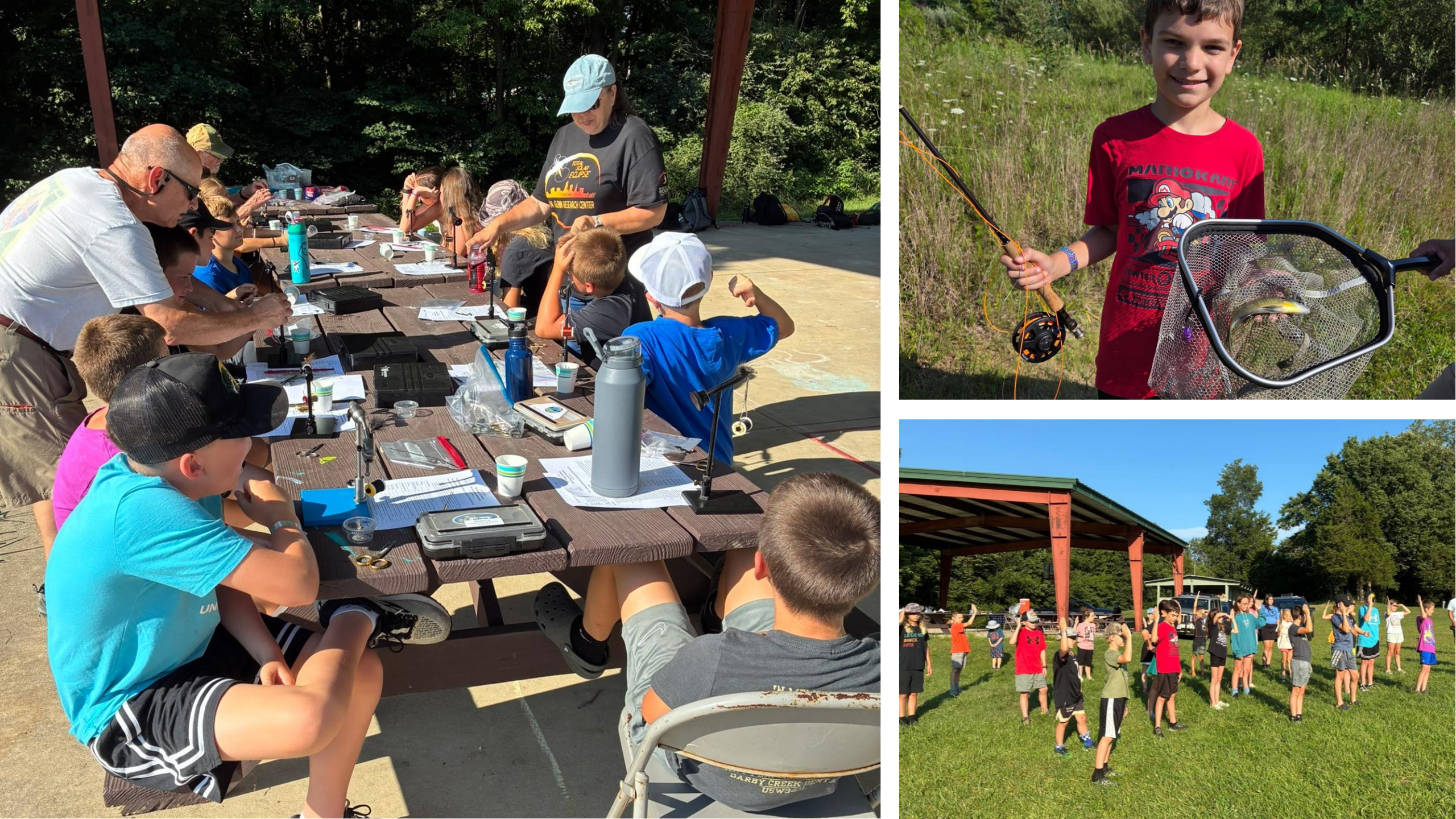
On June 10, 2025, our TU volunteers partnered with Bellefontaine High School for the Logan County Summer Enrichment Academy. Sixteen students in grades 4–8 spent the day learning the basics of fly fishing through hands-on stations led by John Davis and his team–Ed Meixner, Bob Johnson and Bruce Fox). Activities included fly tying, casting instruction, and an introduction by Ryan Kerns to benthic macroinvertebrates, giving students a deeper look at the insects that fish depend on. The kids were engaged and enthusiastic, and the program was so successful that our team has already been invited back for next year.
by Tom Allen, TU Mad River Chapter
The Mad River Chapter of Trout Unlimited was honored to be invited to take part in Logan County Land Trust’s Enviro-Camp this summer. Campers had the chance to learn the basics of fly fishing and fly tying while connecting with the outdoors in a hands-on way.
We’re grateful to the Land Trust for including us in the program—and for their donation to support our work protecting and restoring the Mad River. Partnerships like these help us continue our conservation and education efforts for future generations.
Chapter Member Attends Teen Expedition in Southern Oregon
by Jason Tolman II, TU Mad River Chapter member
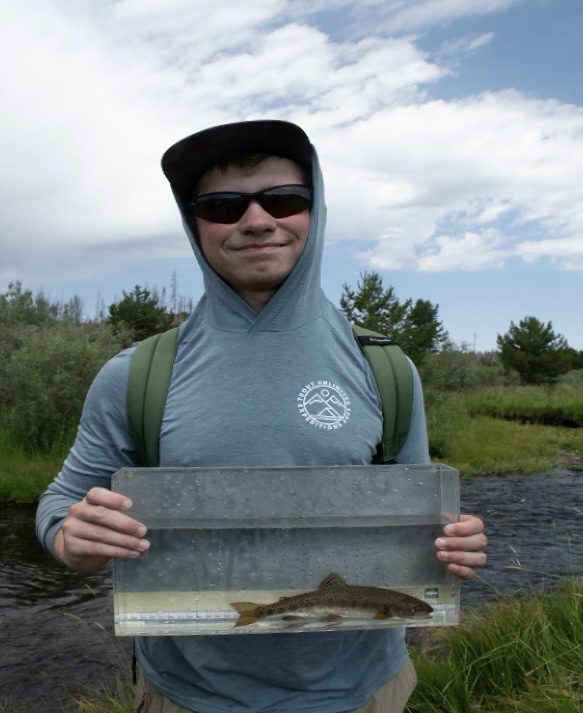
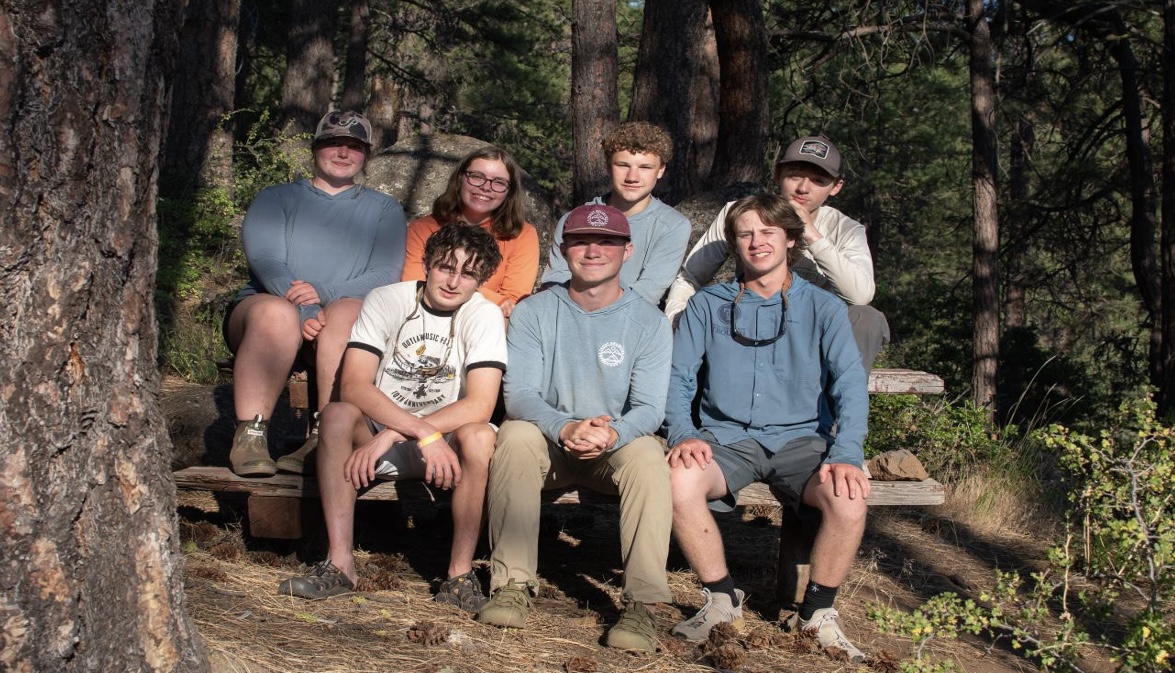
My name is Jason Tolman and I am a junior at Hilliard Darby High school in Hilliard, Ohio. I was very fortunate to be selected to go on this summer’s Trout Unlimited Teen Expedition in Southern Oregon. I had only been fly fishing a handful of times before applying for this trip, so I went into it with an aspiration to learn about not only fly fishing, but also the work that Trout Unlimited does out west.
The Klamath River Restoration
The first few days of the expedition were educational days, meant to inform us of the role that Trout Unlimited has played in the renewal of the Klamath River in Southern Oregon and Northern California. Over the past century, the Klamath River has had a series of hydroelectric dams blocking fish from travelling upstream, greatly affecting anadromous fish that need to travel upstream to spawn (e.g. Chinook Salmon). The anadromous fish have been forced to spawn in the lower basin of the Klamath River, causing salmon to disappear completely from the entire upper Klamath River Basin in Oregon.
The Klamath River Renewal Corporation (KRRC) was founded in 2016 following a federal settlement with the energy company PacifiCorp. This settlement required PacifiCorp to decommission four dams along the Klamath River and transfer the ownership of them to the KRRC. The dam removals began in 2023 with the demolition of the Copco No. 2 dam and continued into 2024 with the removal of the J.C. Boyles, Irongate and Copco No. 1 dams.
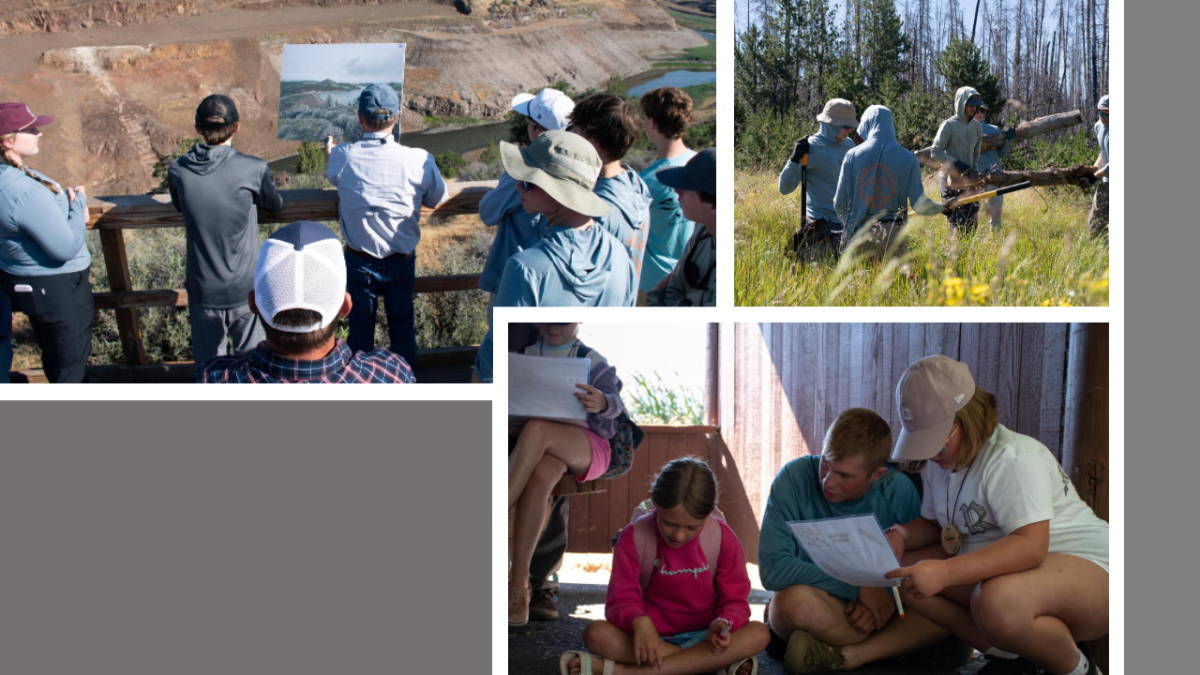
When the Irongate dam was removed, it was expected that salmon would take a handful of years to travel upstream to Oregon. However, it came as a great surprise that salmon were found in Oregon just two weeks after Irongate fell. During the first few days of the expedition, I was able to visit the former sites of both the Irongate and J.C. Boyles dams.
Youth-Led Education
During our last day on the Klamath, we went down to the wetlands in California to teach kids about aquatic macroinvertebrates as part of a larger natural resources focused day camp. This day was relatively short, only spending two hours at the site. The Trout Unlimited group helped kids identify a plethora of different types of macroinvertebrates that they could find in the wetland in which the day camp was located. After a few short hours at this site, we travelled north to the Sprague River, where we would spend the majority of the expedition.
Restoring The Sprague
Our time in the Fremont National Forest was spent working in the Sprague River. A century of cattle grazing and the introduction of non-native brook trout have had a detrimental effect on the Sprague. The first two days at the Sprague were spent creating and repairing Beaver Dam Analogues (BDA’s). A BDA is constructed with sod and stuffings (e.g. willow, conifer branches, sage, etc.). First, we would place down the sod in the part of the river we wanted to redirect. Next we would cover the sod with stuffings, and we would repeat this until the water had been adequately redirected. This process would take hours for each structure to be completed. Some people would have to dig up sod while others would be cutting down trees whenever new material was needed. By the time we had left the site, we had built and patched nine Beaver Dam Analogues. The next task for the group was to monitor the fish populations in the river. While we fished the Sprague, we could see very clearly that the invasive brook trout had taken over the river. Every cast would see action, and you could be almost certain that it was another little brook taking your fly. Out of over a hundred fish caught, only a couple were the native Redband rainbow trout. The last day on the Sprague was spent electroshock fishing for trout. Out of the many fish caught, less than ten were rainbow trout, and only one was a brown trout. The brook trout had taken over the river and were harming the already sick river. Following the electroshock fishing, we traveled back to Klamath Falls to finish the expedition.
Wrapping it up
Over the week spent in Oregon, I not only learned how to fly fish, but I also got the opportunity to learn about the important work that conservation groups such as Trout Unlimited are doing out west. From surveying the former dam sites and the work being done to restore the Klamath River, to actually being able to be involved in the restoration of the Sprague River, I felt like I was a part of this cause. I had an unforgettable time this year, and I hope that I am able to experience this again next year and for many years to come.
This experience reinforced my desire to study conservation science in college.
Upcoming Events
Latest News
- One Calendar for Our Fly Fishing & Outdoor Community
- Mad River Drift Newsletter - September 2026
- 10/16/26 -International Fly Fishing Film Festival at Nocterra Brewing, Powell
- Mad River Drift Newsletter - June 2026
- Cancelled — Saturday’s Stream Water Quality Monitoring
- Reminder: Mad River TU Annual Meeting – April 18
- Mad River Drift Newsletter - March 2026